Download for free now
Thank you! Your submission has been received!
Oops! Something went wrong while submitting the form.



Insurance operates on confidence. That confidence is built through consistent decision-making, clear governance and predictable application of controls, particularly under pressure. When working patterns are treated as short-term accommodations, ambiguity enters these foundations through inconsistent expectations and uneven oversight. When they are embedded into day-to-day operation, they reinforce them.
Sectors with high regulatory and risk exposure have little tolerance for inconsistency. In insurance, this is visible in how quickly unclear expectations affect decision cadence, knowledge continuity and accountability. When intent is clearly set, improvisation falls away. Leaders can rely on work taking place in appropriate settings, with proportionate oversight, without continual correction.
In established insurance environments, hybrid working is not framed as a question of location. It sits within workforce strategy, aligned to how judgement, collaboration and expertise are sustained over time. This distinction matters. Policies regulate behaviour. Strategy shapes how performance is produced.
Underwriting decisions, claims resolution and risk assessment depend as much on accumulated experience as on formal process. What differentiates well-embedded approaches is how professional judgement is transferred, tested and reinforced over time. This can be seen in how senior practitioners remain accessible, how complex decisions are convened, and how teams maintain rhythm across portfolios that demand consistency. Where work happens is treated as inseparable from how confidence is built and maintained.

Secure hybrid working is a baseline requirement in insurance. Maturity is reflected in how technology and security support governance without drawing attention to themselves. Robust systems create the conditions for trust, but they do not create trust on their own.
In regulated environments, reliability matters more than novelty. Systems that behave unpredictably or change too frequently erode confidence. Where hybrid working is fully embedded, technology enables smooth transitions between focused analysis, collaborative judgement and formal assurance. Security supports auditability and continuity, allowing leaders to concentrate on outcomes rather than infrastructure.
In insurance, culture is expressed through professional standards. It is evident in how judgement is formed, reviewed and upheld. The clearest signal of maturity appears in how long-tenure expertise and tacit knowledge are preserved in distributed settings.
In insurance, this takes the form of apprenticeship-style learning, peer challenge and collective review of decisions. Deliberate moments of togetherness support the transfer of judgement that cannot be codified. Career progression remains anchored in demonstrated competence and decision integrity, rather than visibility or presence. Standards are sustained through structure and expectation, not sentiment.
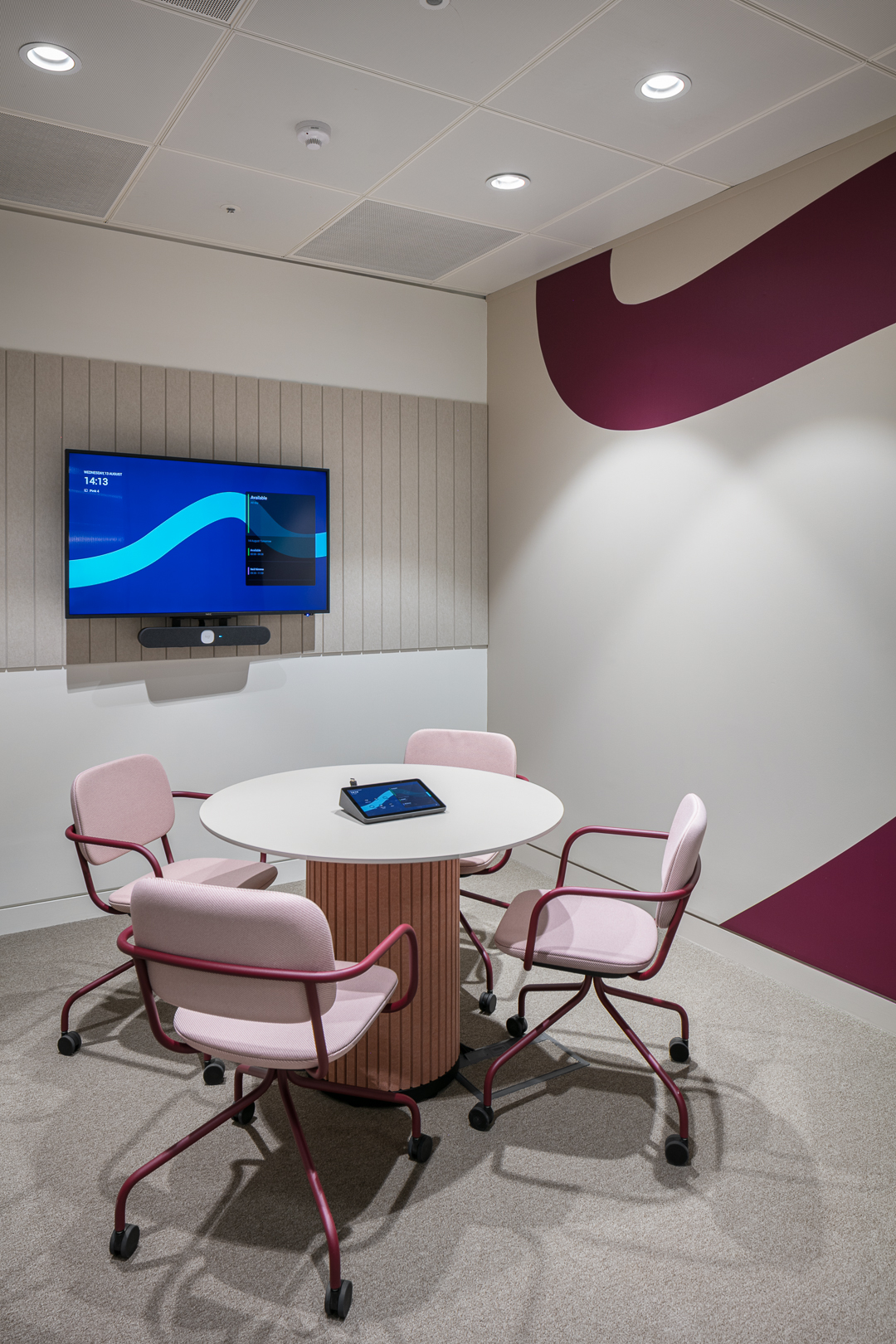
Physical workplaces continue to matter, but their role is precise. They provide settings for decisions that benefit from shared context, for governance moments that require presence, and for reinforcing collective responsibility.
In well-established models, the workplace is not an attendance mechanism. Its use reflects clear judgement about when presence adds value and why. This clarity reduces ambiguity and reinforces trust internally and externally. Expectations are communicated through how space is used, rather than through prescriptive rules.
Decisions about cost and carbon sit alongside capital discipline and long-term risk horizons. They are subject to board scrutiny and investor attention, particularly where ESG credibility intersects with regulatory expectations.
Where working patterns are coherently embedded, choices about space, utilisation and energy performance follow from how work is conducted. Right-sizing becomes a consequence of clarity, not a corrective measure. Organisations with stable operating models are better able to align cost control, environmental performance and delivery standards without undermining confidence.
When hybrid working is fully embedded, leadership attention shifts. Time previously spent managing exceptions is redirected towards sustaining judgement quality, resilience and strategic focus. The operating model recedes from view and becomes an assumption rather than a topic.
For insurance leaders, this point is reached when working patterns can be relied upon as part of the control environment, supporting governance, reinforcing professional standards and standing up to scrutiny over time.

Insurance operates on confidence. That confidence is built through consistent decision-making, clear governance and predictable application of controls, particularly under pressure. When working patterns are treated as short-term accommodations, ambiguity enters these foundations through inconsistent expectations and uneven oversight. When they are embedded into day-to-day operation, they reinforce them.
Sectors with high regulatory and risk exposure have little tolerance for inconsistency. In insurance, this is visible in how quickly unclear expectations affect decision cadence, knowledge continuity and accountability. When intent is clearly set, improvisation falls away. Leaders can rely on work taking place in appropriate settings, with proportionate oversight, without continual correction.
In established insurance environments, hybrid working is not framed as a question of location. It sits within workforce strategy, aligned to how judgement, collaboration and expertise are sustained over time. This distinction matters. Policies regulate behaviour. Strategy shapes how performance is produced.
Underwriting decisions, claims resolution and risk assessment depend as much on accumulated experience as on formal process. What differentiates well-embedded approaches is how professional judgement is transferred, tested and reinforced over time. This can be seen in how senior practitioners remain accessible, how complex decisions are convened, and how teams maintain rhythm across portfolios that demand consistency. Where work happens is treated as inseparable from how confidence is built and maintained.
Secure hybrid working is a baseline requirement in insurance. Maturity is reflected in how technology and security support governance without drawing attention to themselves. Robust systems create the conditions for trust, but they do not create trust on their own.
In regulated environments, reliability matters more than novelty. Systems that behave unpredictably or change too frequently erode confidence. Where hybrid working is fully embedded, technology enables smooth transitions between focused analysis, collaborative judgement and formal assurance. Security supports auditability and continuity, allowing leaders to concentrate on outcomes rather than infrastructure.
In insurance, culture is expressed through professional standards. It is evident in how judgement is formed, reviewed and upheld. The clearest signal of maturity appears in how long-tenure expertise and tacit knowledge are preserved in distributed settings.
In insurance, this takes the form of apprenticeship-style learning, peer challenge and collective review of decisions. Deliberate moments of togetherness support the transfer of judgement that cannot be codified. Career progression remains anchored in demonstrated competence and decision integrity, rather than visibility or presence. Standards are sustained through structure and expectation, not sentiment.
Physical workplaces continue to matter, but their role is precise. They provide settings for decisions that benefit from shared context, for governance moments that require presence, and for reinforcing collective responsibility.
In well-established models, the workplace is not an attendance mechanism. Its use reflects clear judgement about when presence adds value and why. This clarity reduces ambiguity and reinforces trust internally and externally. Expectations are communicated through how space is used, rather than through prescriptive rules.
Decisions about cost and carbon sit alongside capital discipline and long-term risk horizons. They are subject to board scrutiny and investor attention, particularly where ESG credibility intersects with regulatory expectations.
Where working patterns are coherently embedded, choices about space, utilisation and energy performance follow from how work is conducted. Right-sizing becomes a consequence of clarity, not a corrective measure. Organisations with stable operating models are better able to align cost control, environmental performance and delivery standards without undermining confidence.
When hybrid working is fully embedded, leadership attention shifts. Time previously spent managing exceptions is redirected towards sustaining judgement quality, resilience and strategic focus. The operating model recedes from view and becomes an assumption rather than a topic.
For insurance leaders, this point is reached when working patterns can be relied upon as part of the control environment, supporting governance, reinforcing professional standards and standing up to scrutiny over time.

Insurance operates on confidence. That confidence is built through consistent decision-making, clear governance and predictable application of controls, particularly under pressure. When working patterns are treated as short-term accommodations, ambiguity enters these foundations through inconsistent expectations and uneven oversight. When they are embedded into day-to-day operation, they reinforce them.
Sectors with high regulatory and risk exposure have little tolerance for inconsistency. In insurance, this is visible in how quickly unclear expectations affect decision cadence, knowledge continuity and accountability. When intent is clearly set, improvisation falls away. Leaders can rely on work taking place in appropriate settings, with proportionate oversight, without continual correction.
In established insurance environments, hybrid working is not framed as a question of location. It sits within workforce strategy, aligned to how judgement, collaboration and expertise are sustained over time. This distinction matters. Policies regulate behaviour. Strategy shapes how performance is produced.
Underwriting decisions, claims resolution and risk assessment depend as much on accumulated experience as on formal process. What differentiates well-embedded approaches is how professional judgement is transferred, tested and reinforced over time. This can be seen in how senior practitioners remain accessible, how complex decisions are convened, and how teams maintain rhythm across portfolios that demand consistency. Where work happens is treated as inseparable from how confidence is built and maintained.
Secure hybrid working is a baseline requirement in insurance. Maturity is reflected in how technology and security support governance without drawing attention to themselves. Robust systems create the conditions for trust, but they do not create trust on their own.
In regulated environments, reliability matters more than novelty. Systems that behave unpredictably or change too frequently erode confidence. Where hybrid working is fully embedded, technology enables smooth transitions between focused analysis, collaborative judgement and formal assurance. Security supports auditability and continuity, allowing leaders to concentrate on outcomes rather than infrastructure.
In insurance, culture is expressed through professional standards. It is evident in how judgement is formed, reviewed and upheld. The clearest signal of maturity appears in how long-tenure expertise and tacit knowledge are preserved in distributed settings.
In insurance, this takes the form of apprenticeship-style learning, peer challenge and collective review of decisions. Deliberate moments of togetherness support the transfer of judgement that cannot be codified. Career progression remains anchored in demonstrated competence and decision integrity, rather than visibility or presence. Standards are sustained through structure and expectation, not sentiment.
Physical workplaces continue to matter, but their role is precise. They provide settings for decisions that benefit from shared context, for governance moments that require presence, and for reinforcing collective responsibility.
In well-established models, the workplace is not an attendance mechanism. Its use reflects clear judgement about when presence adds value and why. This clarity reduces ambiguity and reinforces trust internally and externally. Expectations are communicated through how space is used, rather than through prescriptive rules.
Decisions about cost and carbon sit alongside capital discipline and long-term risk horizons. They are subject to board scrutiny and investor attention, particularly where ESG credibility intersects with regulatory expectations.
Where working patterns are coherently embedded, choices about space, utilisation and energy performance follow from how work is conducted. Right-sizing becomes a consequence of clarity, not a corrective measure. Organisations with stable operating models are better able to align cost control, environmental performance and delivery standards without undermining confidence.
When hybrid working is fully embedded, leadership attention shifts. Time previously spent managing exceptions is redirected towards sustaining judgement quality, resilience and strategic focus. The operating model recedes from view and becomes an assumption rather than a topic.
For insurance leaders, this point is reached when working patterns can be relied upon as part of the control environment, supporting governance, reinforcing professional standards and standing up to scrutiny over time.