Download for free now
Thank you! Your submission has been received!
Oops! Something went wrong while submitting the form.


_smaller.jpg)
The question in 2026 is shifting from ‘what to install in our next workplace transformation?’, to ‘what can be reused, or redeployed elsewhere?’. Circularity in workplace design is now a commercial as well as environmental priority. Modular layouts, demountable partitions, repurposed materials and reuse of existing materials are reducing embodied carbon and allowing organisations to evolve without the need for wholesale rebuilds.
Material specification is becoming data-led. Environmental Product Declarations (EPDs) and embodied carbon calculations are informing decisions from concept stage, allowing designers to make informed decisions on which materials and items offer a lower carbon alternative. This is especially evident in the selection of finishes, flooring and M&E systems.
At TSK, we have also developed a carbon estimation tool that allows us to inform clients of a project’s carbon hotspots based on initial designs and concepts. This enables both our clients and designers to collaborate in identifying opportunities to reduce embodied carbon through intelligent and considered design interventions.
Businesses are moving away from large, static footprints to compact and multifunctional environments. Many are reducing their workplace floorspace by 20% to 40%, while increasing usability through dynamic workplace settings that better match the requirements of the occupants using the space.
Smaller, better-used workplaces not only reduce overhead costs, but can cut operational emissions, reduce energy loads and concentrate investment where it has the most impact, such as boosting productivity, stimulating creativity and attracting and retaining talent.
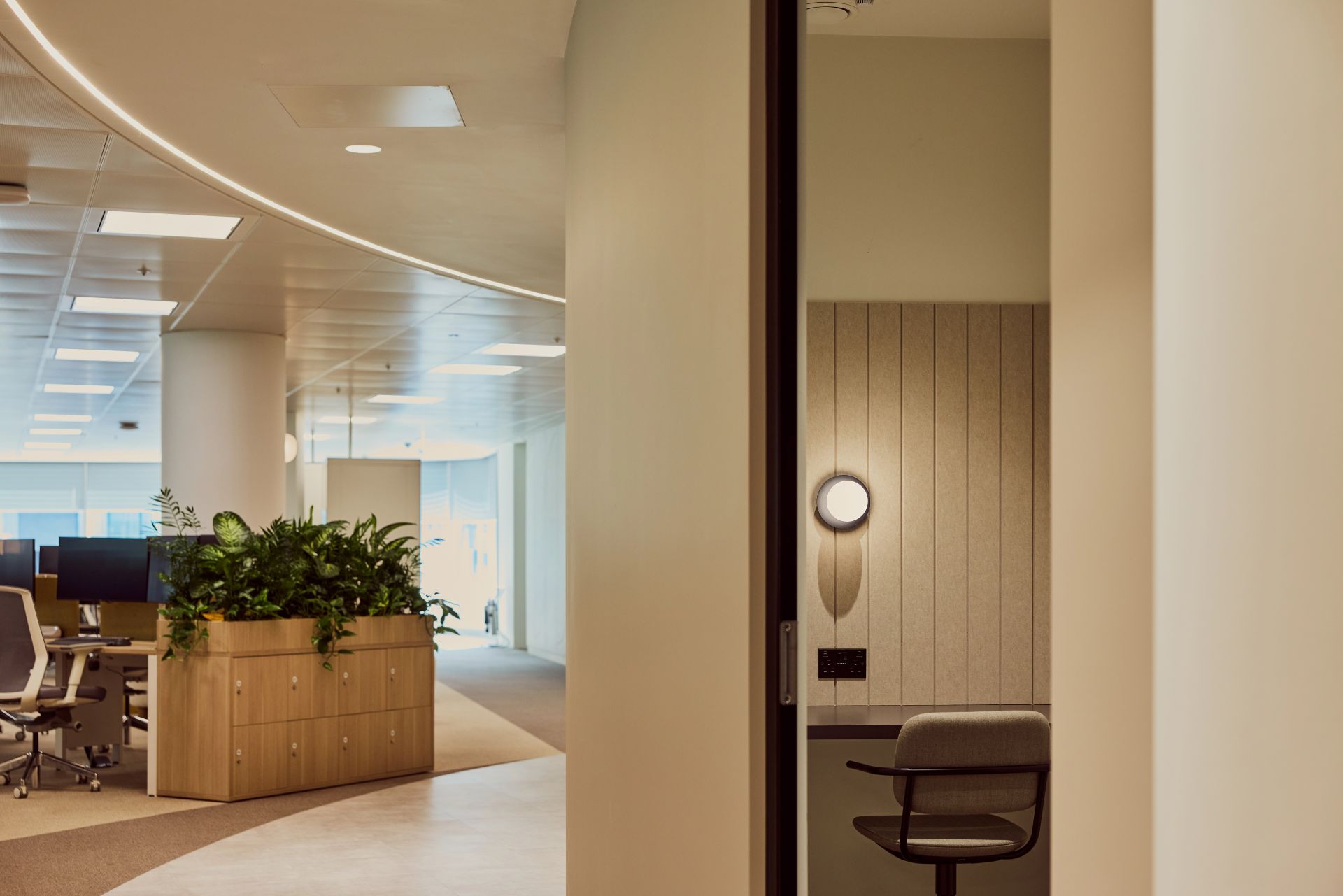
Wellbeing and sustainability have converged, and quite rightly so. Certifications such as WELL and Fitwel - both internationally recognised - are being used alongside UK-based standards like BREEAM and NABERS UK to guide the design of spaces that support both human and environmental performance. The SKA Rating Scheme is also working on a new wellbeing standard in 2026, which can be achieved alongside the new SKA Rating for offices scheme.
This integrated approach is driving more access to daylight and fresh air, lower levels of volatile organic compounds, improved acoustic conditions, and spaces that enable privacy, movement and recovery. Healthy, sustainability-centred buildings perform better both operationally, whilst also delivering for the people who work there and the wider planet in equal measure.

Sensor-led systems are becoming standard in sustainable workplace design, and we are expecting this trend to continue into 2026. From energy use, air quality, temperature and occupancy monitoring in real-time, enabling continuous optimisation, to meeting room and active travel facilities booking systems, making the user experience seamless.
Alongside this, there is growing recognition of the importance of post-occupancy evaluation - not just as a reporting function, but as a critical feedback loop for improvement. In high-performing workplaces, sensor data is increasingly being paired with behavioural insights and gentle nudges to help teams adopt more sustainable practices over time.
This is especially important for organisations reporting against net-zero or ESG targets, whilst maximising efficiency and creating a first-rate user experience.
Our vision for 2026 is clear: the workplaces delivering true sustainability are those designed for intelligent performance and continuous improvement. We focus on creating environments that are flexible, measurable and future-ready, using modular and circular principles to minimise resource use and embodied carbon.
By integrating health and wellbeing standards with advanced sensor-led systems - and learning from how spaces are actually used - we build workplaces that respond dynamically to occupant needs and operational demands. For us, sustainable design is a strategic commitment to clarity, credibility and proven results, helping our clients achieve real business success while supporting people and planet in equal measure.
The question in 2026 is shifting from ‘what to install in our next workplace transformation?’, to ‘what can be reused, or redeployed elsewhere?’. Circularity in workplace design is now a commercial as well as environmental priority. Modular layouts, demountable partitions, repurposed materials and reuse of existing materials are reducing embodied carbon and allowing organisations to evolve without the need for wholesale rebuilds.
Material specification is becoming data-led. Environmental Product Declarations (EPDs) and embodied carbon calculations are informing decisions from concept stage, allowing designers to make informed decisions on which materials and items offer a lower carbon alternative. This is especially evident in the selection of finishes, flooring and M&E systems.
At TSK, we have also developed a carbon estimation tool that allows us to inform clients of a project’s carbon hotspots based on initial designs and concepts. This enables both our clients and designers to collaborate in identifying opportunities to reduce embodied carbon through intelligent and considered design interventions.
Businesses are moving away from large, static footprints to compact and multifunctional environments. Many are reducing their workplace floorspace by 20% to 40%, while increasing usability through dynamic workplace settings that better match the requirements of the occupants using the space.
Smaller, better-used workplaces not only reduce overhead costs, but can cut operational emissions, reduce energy loads and concentrate investment where it has the most impact, such as boosting productivity, stimulating creativity and attracting and retaining talent.
Wellbeing and sustainability have converged, and quite rightly so. Certifications such as WELL and Fitwel - both internationally recognised - are being used alongside UK-based standards like BREEAM and NABERS UK to guide the design of spaces that support both human and environmental performance. The SKA Rating Scheme is also working on a new wellbeing standard in 2026, which can be achieved alongside the new SKA Rating for offices scheme.
This integrated approach is driving more access to daylight and fresh air, lower levels of volatile organic compounds, improved acoustic conditions, and spaces that enable privacy, movement and recovery. Healthy, sustainability-centred buildings perform better both operationally, whilst also delivering for the people who work there and the wider planet in equal measure.
Sensor-led systems are becoming standard in sustainable workplace design, and we are expecting this trend to continue into 2026. From energy use, air quality, temperature and occupancy monitoring in real-time, enabling continuous optimisation, to meeting room and active travel facilities booking systems, making the user experience seamless.
Alongside this, there is growing recognition of the importance of post-occupancy evaluation - not just as a reporting function, but as a critical feedback loop for improvement. In high-performing workplaces, sensor data is increasingly being paired with behavioural insights and gentle nudges to help teams adopt more sustainable practices over time.
This is especially important for organisations reporting against net-zero or ESG targets, whilst maximising efficiency and creating a first-rate user experience.
Our vision for 2026 is clear: the workplaces delivering true sustainability are those designed for intelligent performance and continuous improvement. We focus on creating environments that are flexible, measurable and future-ready, using modular and circular principles to minimise resource use and embodied carbon.
By integrating health and wellbeing standards with advanced sensor-led systems - and learning from how spaces are actually used - we build workplaces that respond dynamically to occupant needs and operational demands. For us, sustainable design is a strategic commitment to clarity, credibility and proven results, helping our clients achieve real business success while supporting people and planet in equal measure.

The question in 2026 is shifting from ‘what to install in our next workplace transformation?’, to ‘what can be reused, or redeployed elsewhere?’. Circularity in workplace design is now a commercial as well as environmental priority. Modular layouts, demountable partitions, repurposed materials and reuse of existing materials are reducing embodied carbon and allowing organisations to evolve without the need for wholesale rebuilds.
Material specification is becoming data-led. Environmental Product Declarations (EPDs) and embodied carbon calculations are informing decisions from concept stage, allowing designers to make informed decisions on which materials and items offer a lower carbon alternative. This is especially evident in the selection of finishes, flooring and M&E systems.
At TSK, we have also developed a carbon estimation tool that allows us to inform clients of a project’s carbon hotspots based on initial designs and concepts. This enables both our clients and designers to collaborate in identifying opportunities to reduce embodied carbon through intelligent and considered design interventions.
Businesses are moving away from large, static footprints to compact and multifunctional environments. Many are reducing their workplace floorspace by 20% to 40%, while increasing usability through dynamic workplace settings that better match the requirements of the occupants using the space.
Smaller, better-used workplaces not only reduce overhead costs, but can cut operational emissions, reduce energy loads and concentrate investment where it has the most impact, such as boosting productivity, stimulating creativity and attracting and retaining talent.
Wellbeing and sustainability have converged, and quite rightly so. Certifications such as WELL and Fitwel - both internationally recognised - are being used alongside UK-based standards like BREEAM and NABERS UK to guide the design of spaces that support both human and environmental performance. The SKA Rating Scheme is also working on a new wellbeing standard in 2026, which can be achieved alongside the new SKA Rating for offices scheme.
This integrated approach is driving more access to daylight and fresh air, lower levels of volatile organic compounds, improved acoustic conditions, and spaces that enable privacy, movement and recovery. Healthy, sustainability-centred buildings perform better both operationally, whilst also delivering for the people who work there and the wider planet in equal measure.
Sensor-led systems are becoming standard in sustainable workplace design, and we are expecting this trend to continue into 2026. From energy use, air quality, temperature and occupancy monitoring in real-time, enabling continuous optimisation, to meeting room and active travel facilities booking systems, making the user experience seamless.
Alongside this, there is growing recognition of the importance of post-occupancy evaluation - not just as a reporting function, but as a critical feedback loop for improvement. In high-performing workplaces, sensor data is increasingly being paired with behavioural insights and gentle nudges to help teams adopt more sustainable practices over time.
This is especially important for organisations reporting against net-zero or ESG targets, whilst maximising efficiency and creating a first-rate user experience.
Our vision for 2026 is clear: the workplaces delivering true sustainability are those designed for intelligent performance and continuous improvement. We focus on creating environments that are flexible, measurable and future-ready, using modular and circular principles to minimise resource use and embodied carbon.
By integrating health and wellbeing standards with advanced sensor-led systems - and learning from how spaces are actually used - we build workplaces that respond dynamically to occupant needs and operational demands. For us, sustainable design is a strategic commitment to clarity, credibility and proven results, helping our clients achieve real business success while supporting people and planet in equal measure.