


Download for free now
Thank you! Your submission has been received!
Oops! Something went wrong while submitting the form.


The location of a workplace significantly influences how people get there. Offices near public transport hubs naturally support low-carbon commuting, helping more employees swap private cars for trains, trams, buses, or active travel options like walking and cycling.
Design also plays a role. Providing the right facilities, such as secure bike storage, EV charging, shower rooms, and lockers, removes barriers to greener journeys. These choices help to reduce emissions from daily commuting, which are typically among the most visible and measurable scope 3 contributors.
The benefits go beyond carbon. Shorter, stress-free commutes support wellbeing, while local communities benefit from cleaner air and reduced congestion.
Location and layout also influence the volume of business travel. Offices close to major stations or transport links make sustainable travel for client meetings and events more viable. Just as importantly, the rise of hybrid working and virtual engagement creates opportunities to reduce travel altogether.
Designing workplaces with high-quality virtual collaboration zones enables teams to connect remotely without compromising effectiveness. This not only reduces emissions associated with flights and long-distance travel but gives people greater control over how they manage their time and energy.
The day-to-day workings of a space - from food packaging to cleaning supplies - generate a steady stream of waste. While often overlooked, these operations fall squarely within Scope 3.
Designing with circularity in mind means creating systems that prevent waste at the source and encourage responsible behaviours. Spaces that make recycling simple and visible, suppliers that support reuse and take-back schemes, and prompts that engage teams with performance data all contribute to reduced environmental impact.
A cleaner, more organised workspace can also have a positive knock-on effect on employee morale and accountability - making sustainability feel practical and personal.

For businesses operating from leased premises, scope 3 emissions can include the energy consumed by the building itself. Here, smart workplace design plays a direct role in reducing environmental impact.
Strategies like right-sizing space, integrating low-energy lighting and HVAC systems, and applying occupancy sensors can significantly improve efficiency. These interventions not only lower emissions but ensure that every square metre of space is used with purpose, avoiding the cost and footprint of underused environments.
Comfort, performance, and efficiency all rise in tandem when energy use is aligned with how space is actually experienced.
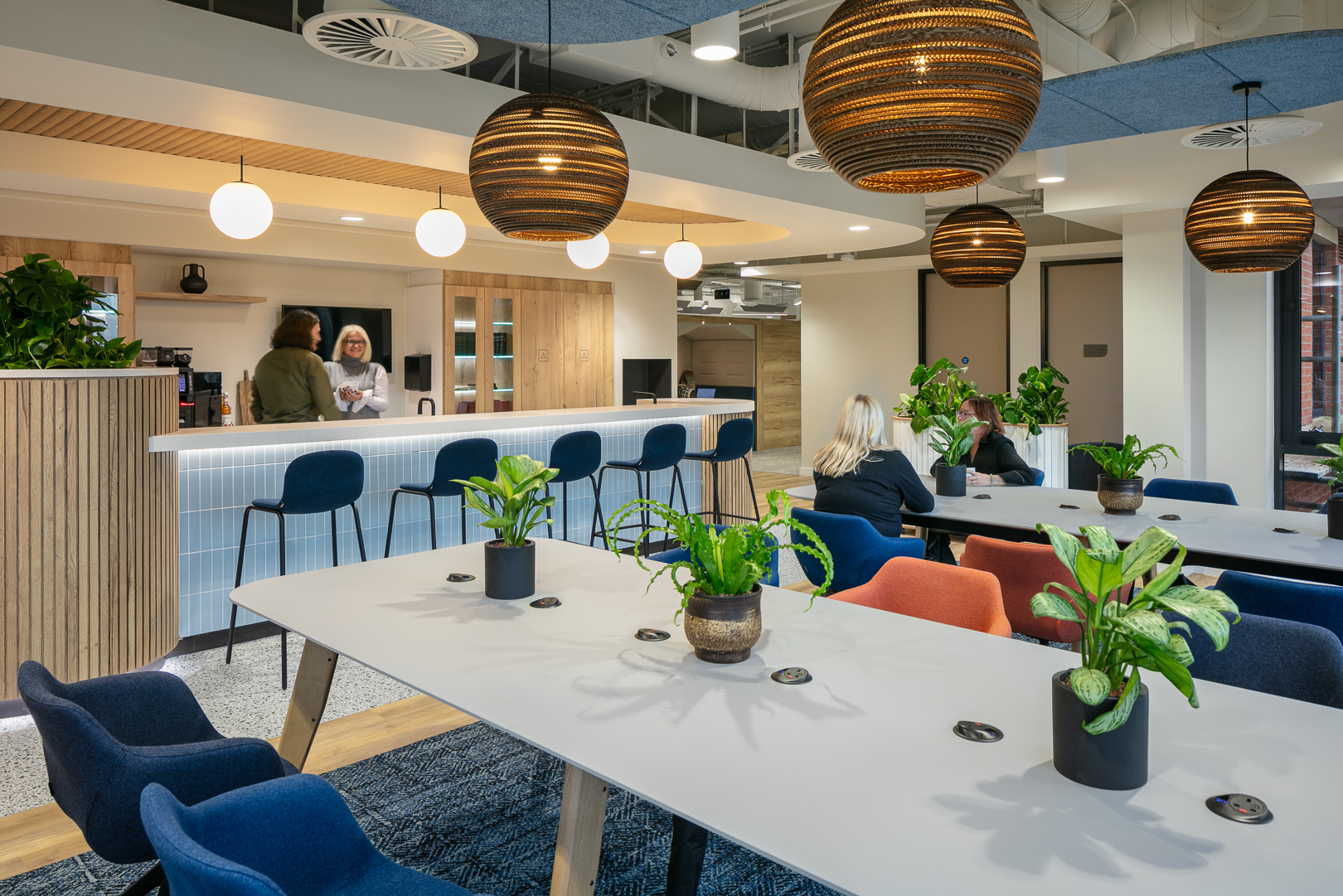
For MPS in Leeds, a sustainably designed workplace offers secure cycling storage, lockers, and shower facilities to support active travel, all just a five-minute walk from Leeds Central Station. The project achieved an EPC Rating B and a BREEAM Excellent award, reflecting its strong performance in energy efficiency and environmental design.
These examples show how intentional design choices, even within existing building parameters, can deliver tangible reductions across several scope 3 categories.
Reducing scope 3 emissions requires cross-functional coordination, but the workplace can act as a catalyst. When organisations make strategic decisions about where they work and how those spaces are designed, they unlock opportunities to shift behaviours, reduce waste, and model sustainability from the inside out.
Every journey to net zero is unique, but for many, the first step is redesigning the space in which those journeys begin.
The location of a workplace significantly influences how people get there. Offices near public transport hubs naturally support low-carbon commuting, helping more employees swap private cars for trains, trams, buses, or active travel options like walking and cycling.
Design also plays a role. Providing the right facilities, such as secure bike storage, EV charging, shower rooms, and lockers, removes barriers to greener journeys. These choices help to reduce emissions from daily commuting, which are typically among the most visible and measurable scope 3 contributors.
The benefits go beyond carbon. Shorter, stress-free commutes support wellbeing, while local communities benefit from cleaner air and reduced congestion.
Location and layout also influence the volume of business travel. Offices close to major stations or transport links make sustainable travel for client meetings and events more viable. Just as importantly, the rise of hybrid working and virtual engagement creates opportunities to reduce travel altogether.
Designing workplaces with high-quality virtual collaboration zones enables teams to connect remotely without compromising effectiveness. This not only reduces emissions associated with flights and long-distance travel but gives people greater control over how they manage their time and energy.
The day-to-day workings of a space - from food packaging to cleaning supplies - generate a steady stream of waste. While often overlooked, these operations fall squarely within Scope 3.
Designing with circularity in mind means creating systems that prevent waste at the source and encourage responsible behaviours. Spaces that make recycling simple and visible, suppliers that support reuse and take-back schemes, and prompts that engage teams with performance data all contribute to reduced environmental impact.
A cleaner, more organised workspace can also have a positive knock-on effect on employee morale and accountability - making sustainability feel practical and personal.
For businesses operating from leased premises, scope 3 emissions can include the energy consumed by the building itself. Here, smart workplace design plays a direct role in reducing environmental impact.
Strategies like right-sizing space, integrating low-energy lighting and HVAC systems, and applying occupancy sensors can significantly improve efficiency. These interventions not only lower emissions but ensure that every square metre of space is used with purpose, avoiding the cost and footprint of underused environments.
Comfort, performance, and efficiency all rise in tandem when energy use is aligned with how space is actually experienced.
For MPS in Leeds, a sustainably designed workplace offers secure cycling storage, lockers, and shower facilities to support active travel, all just a five-minute walk from Leeds Central Station. The project achieved an EPC Rating B and a BREEAM Excellent award, reflecting its strong performance in energy efficiency and environmental design.
These examples show how intentional design choices, even within existing building parameters, can deliver tangible reductions across several scope 3 categories.
Reducing scope 3 emissions requires cross-functional coordination, but the workplace can act as a catalyst. When organisations make strategic decisions about where they work and how those spaces are designed, they unlock opportunities to shift behaviours, reduce waste, and model sustainability from the inside out.
Every journey to net zero is unique, but for many, the first step is redesigning the space in which those journeys begin.

The location of a workplace significantly influences how people get there. Offices near public transport hubs naturally support low-carbon commuting, helping more employees swap private cars for trains, trams, buses, or active travel options like walking and cycling.
Design also plays a role. Providing the right facilities, such as secure bike storage, EV charging, shower rooms, and lockers, removes barriers to greener journeys. These choices help to reduce emissions from daily commuting, which are typically among the most visible and measurable scope 3 contributors.
The benefits go beyond carbon. Shorter, stress-free commutes support wellbeing, while local communities benefit from cleaner air and reduced congestion.
Location and layout also influence the volume of business travel. Offices close to major stations or transport links make sustainable travel for client meetings and events more viable. Just as importantly, the rise of hybrid working and virtual engagement creates opportunities to reduce travel altogether.
Designing workplaces with high-quality virtual collaboration zones enables teams to connect remotely without compromising effectiveness. This not only reduces emissions associated with flights and long-distance travel but gives people greater control over how they manage their time and energy.
The day-to-day workings of a space - from food packaging to cleaning supplies - generate a steady stream of waste. While often overlooked, these operations fall squarely within Scope 3.
Designing with circularity in mind means creating systems that prevent waste at the source and encourage responsible behaviours. Spaces that make recycling simple and visible, suppliers that support reuse and take-back schemes, and prompts that engage teams with performance data all contribute to reduced environmental impact.
A cleaner, more organised workspace can also have a positive knock-on effect on employee morale and accountability - making sustainability feel practical and personal.
For businesses operating from leased premises, scope 3 emissions can include the energy consumed by the building itself. Here, smart workplace design plays a direct role in reducing environmental impact.
Strategies like right-sizing space, integrating low-energy lighting and HVAC systems, and applying occupancy sensors can significantly improve efficiency. These interventions not only lower emissions but ensure that every square metre of space is used with purpose, avoiding the cost and footprint of underused environments.
Comfort, performance, and efficiency all rise in tandem when energy use is aligned with how space is actually experienced.
For MPS in Leeds, a sustainably designed workplace offers secure cycling storage, lockers, and shower facilities to support active travel, all just a five-minute walk from Leeds Central Station. The project achieved an EPC Rating B and a BREEAM Excellent award, reflecting its strong performance in energy efficiency and environmental design.
These examples show how intentional design choices, even within existing building parameters, can deliver tangible reductions across several scope 3 categories.
Reducing scope 3 emissions requires cross-functional coordination, but the workplace can act as a catalyst. When organisations make strategic decisions about where they work and how those spaces are designed, they unlock opportunities to shift behaviours, reduce waste, and model sustainability from the inside out.
Every journey to net zero is unique, but for many, the first step is redesigning the space in which those journeys begin.