Download for free now
Thank you! Your submission has been received!
Oops! Something went wrong while submitting the form.


Over the past decade, workplace sustainability initiatives have primarily concentrated on carbon management, particularly Scope 1 and 2 emissions, and improvements in energy efficiency and operations. As industry awareness has grown, many organisations now possess a strong understanding of these approaches.
However, attention is increasingly turning toward the circular economy as the next significant area of focus.
Circularity represents a fundamental shift; rather than making incremental operational changes, it requires rethinking the design, construction, furnishing, upkeep, and renewal of workspaces in alignment with people, place, and planet. For organisations aiming to reduce both embodied and operational carbon emissions, minimise waste, lower costs, and exemplify authentic sustainability-driven leadership, circularity offers some of the most impactful opportunities available.
Many organisations still equate circularity with “better recycling.” In reality, it’s far more transformative and ultimately adds value to people, place and planet.
According to the Ellen MacArthur Foundation (EMF), the Circular Economy is built on three core principles:
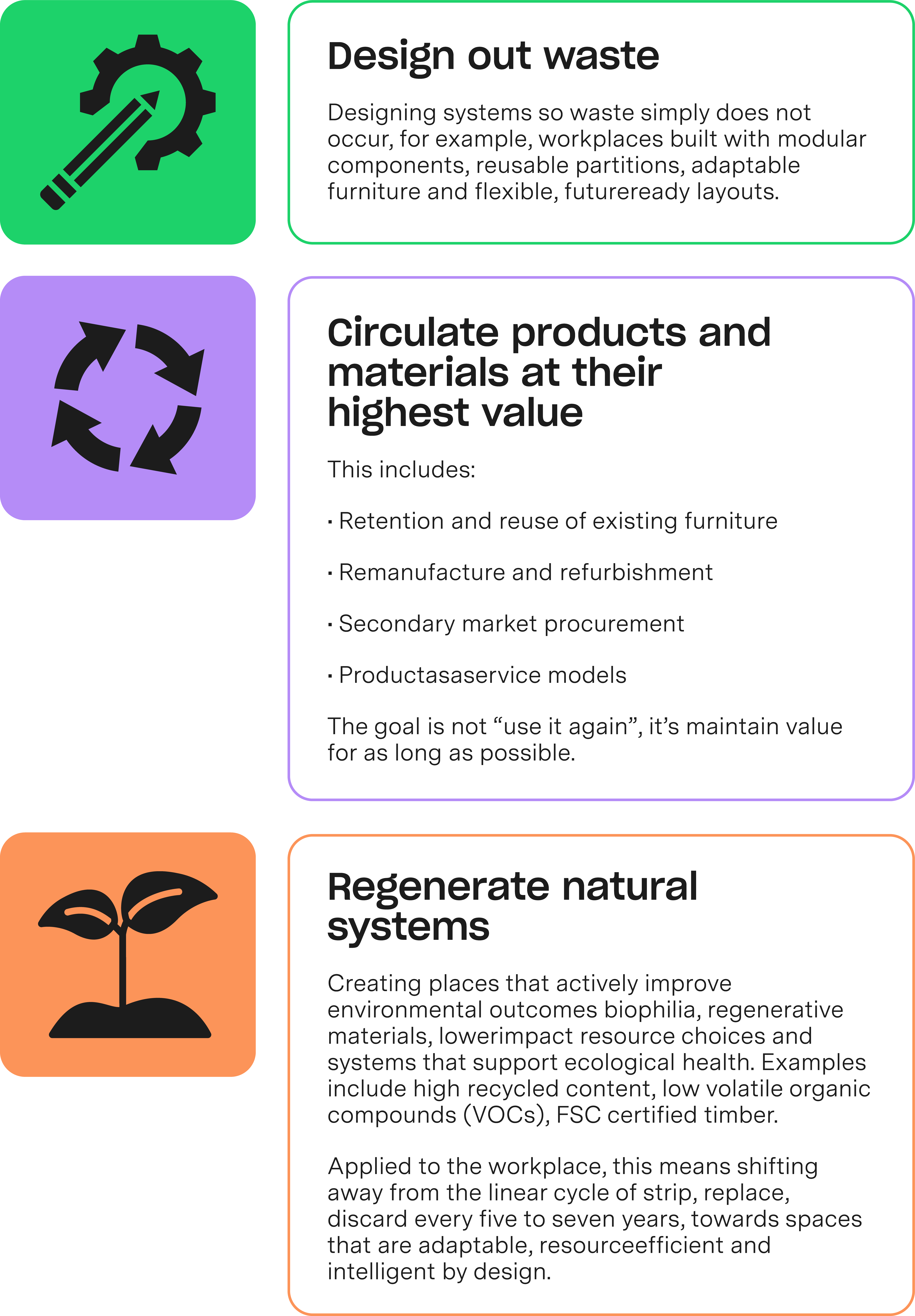
Circularity matters because the workplace sector generates huge waste streams, much of which is entirely avoidable. The following illustrates the scale of the issues the industry is facing.
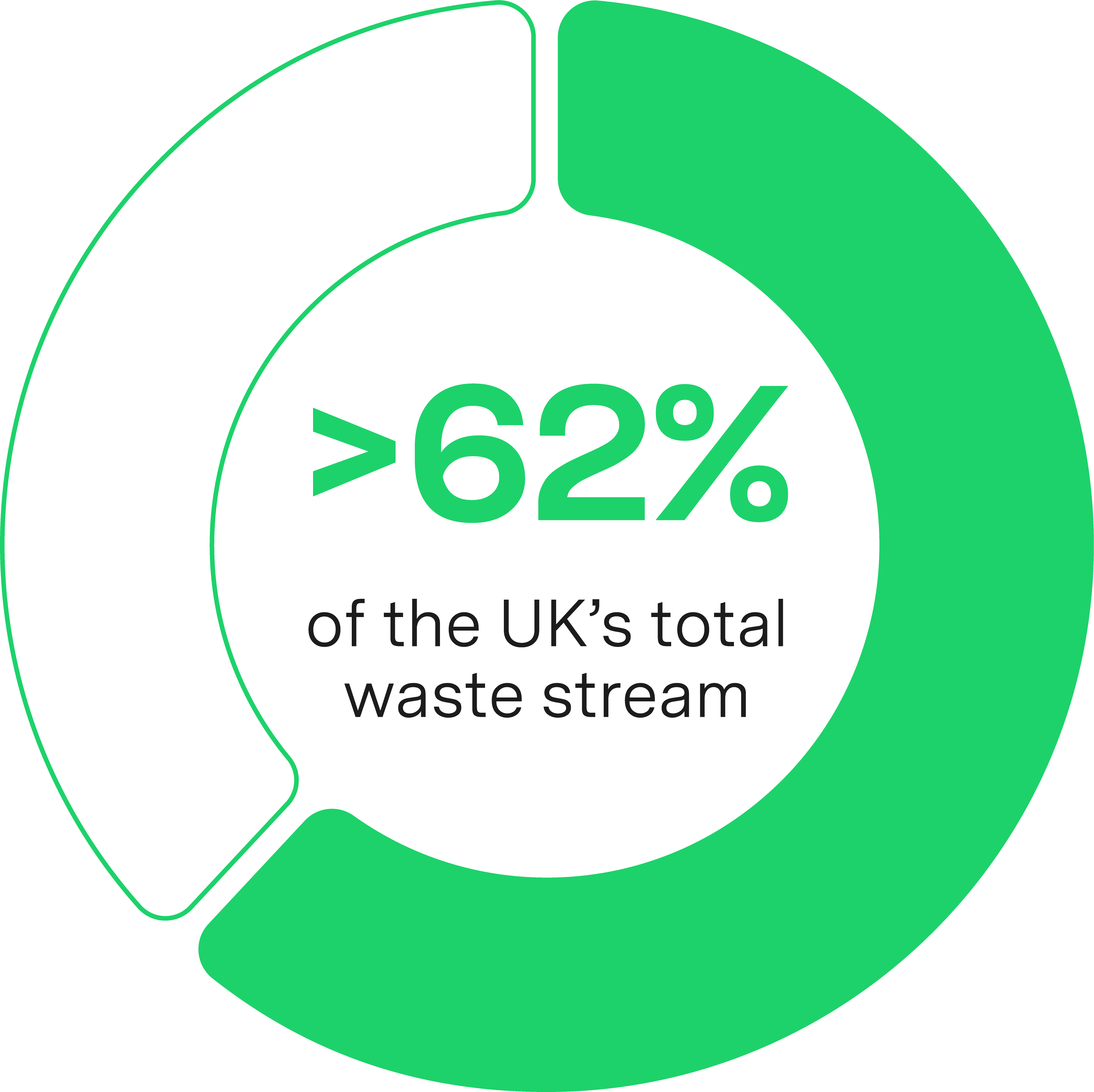
The UK generates more construction waste than any other sector:
WRAP and British Council for Offices (BCO) studies show:
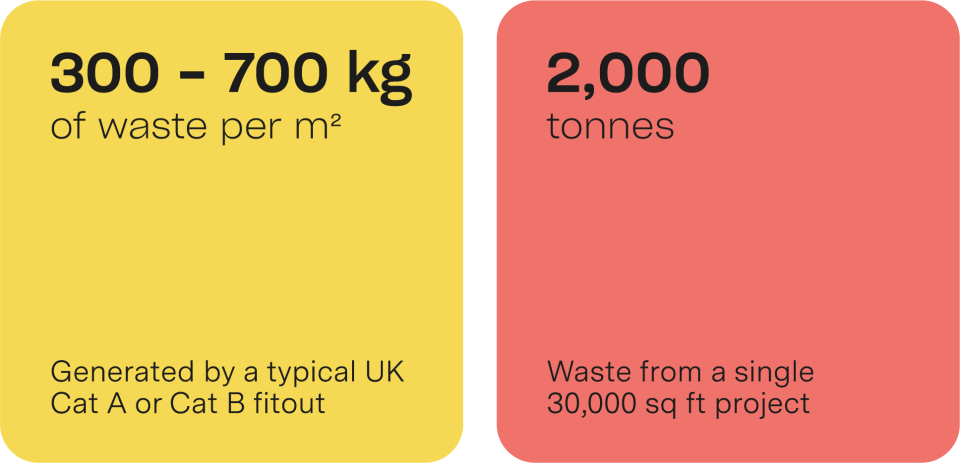
Much of this comprises reusable flooring, partitions, furniture, ceiling tiles and lighting systems.
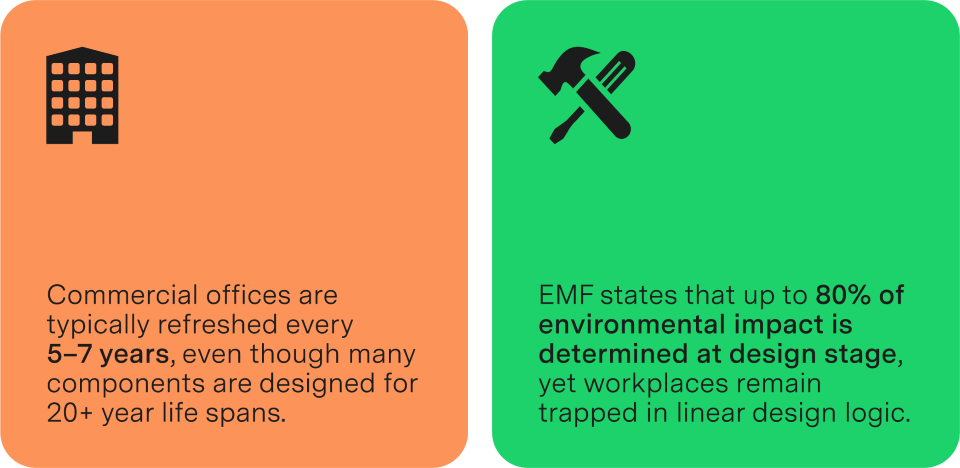
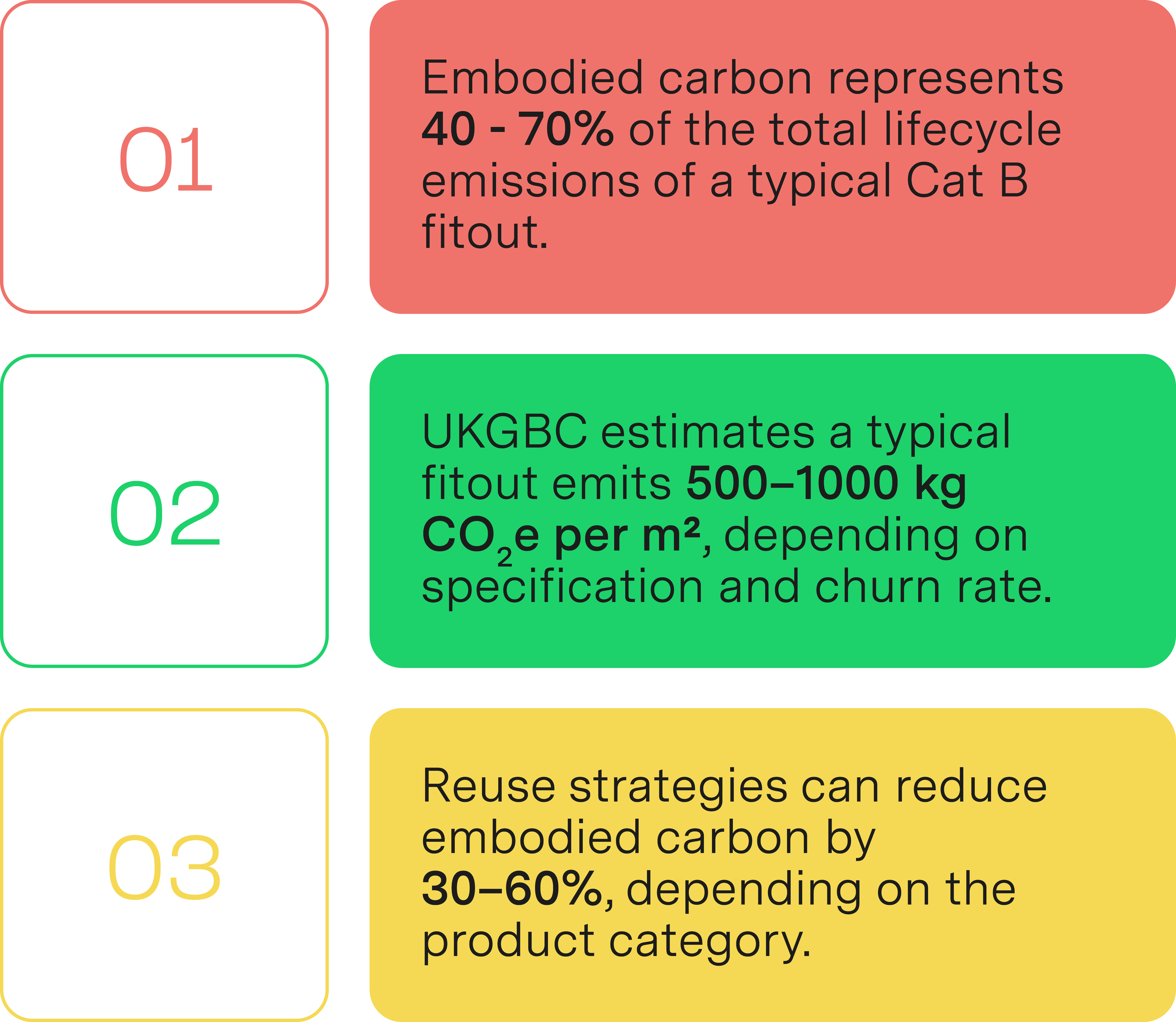
These numbers reveal a system that is environmentally unsustainable, financially inefficient and increasingly out of step with modern ESG expectations.
While operational carbon has declined thanks to renewables and better building systems, embodied carbon remains stubbornly high.
Circular design and procurement reduce carbon immediately, without compromising design intent.
Feedback across TSK’s client base shows common questions emerging:
Circularity turns these questions into quantifiable, project-level outcomes.
Circular approaches commonly reduce capital expenditure by 10-25%, depending on the reuse scope.
With rising material and labour costs, a circular fitout is often the most financially resilient option.
Future articles in this series will explore:
Circularity is not about compromising design quality. It is about designing smarter, extending product life, reducing long-term cost and aligning the workplace with business strategy.

The circular economy is emerging as one of the most important strategic shifts in workplace transformation. It reduces carbon, waste and cost, while aligning organisations with ESG expectations and future regulation.
As the UK workplace sector moves beyond traditional decarbonisation, circularity will be a defining marker of leadership.
This series will unpack how organisations can embed circular principles effectively - and how we are already helping clients make the transition to a smarter, more resilient workplace model.
Over the past decade, workplace sustainability initiatives have primarily concentrated on carbon management, particularly Scope 1 and 2 emissions, and improvements in energy efficiency and operations. As industry awareness has grown, many organisations now possess a strong understanding of these approaches.
However, attention is increasingly turning toward the circular economy as the next significant area of focus.
Circularity represents a fundamental shift; rather than making incremental operational changes, it requires rethinking the design, construction, furnishing, upkeep, and renewal of workspaces in alignment with people, place, and planet. For organisations aiming to reduce both embodied and operational carbon emissions, minimise waste, lower costs, and exemplify authentic sustainability-driven leadership, circularity offers some of the most impactful opportunities available.
Many organisations still equate circularity with “better recycling.” In reality, it’s far more transformative and ultimately adds value to people, place and planet.
According to the Ellen MacArthur Foundation (EMF), the Circular Economy is built on three core principles:
Circularity matters because the workplace sector generates huge waste streams, much of which is entirely avoidable. The following illustrates the scale of the issues the industry is facing.
The UK generates more construction waste than any other sector:
WRAP and British Council for Offices (BCO) studies show:
Much of this comprises reusable flooring, partitions, furniture, ceiling tiles and lighting systems.
These numbers reveal a system that is environmentally unsustainable, financially inefficient and increasingly out of step with modern ESG expectations.
While operational carbon has declined thanks to renewables and better building systems, embodied carbon remains stubbornly high.
Circular design and procurement reduce carbon immediately, without compromising design intent.
Feedback across TSK’s client base shows common questions emerging:
Circularity turns these questions into quantifiable, project-level outcomes.
Circular approaches commonly reduce capital expenditure by 10-25%, depending on the reuse scope.
With rising material and labour costs, a circular fitout is often the most financially resilient option.
Future articles in this series will explore:
Circularity is not about compromising design quality. It is about designing smarter, extending product life, reducing long-term cost and aligning the workplace with business strategy.
The circular economy is emerging as one of the most important strategic shifts in workplace transformation. It reduces carbon, waste and cost, while aligning organisations with ESG expectations and future regulation.
As the UK workplace sector moves beyond traditional decarbonisation, circularity will be a defining marker of leadership.
This series will unpack how organisations can embed circular principles effectively - and how we are already helping clients make the transition to a smarter, more resilient workplace model.
Over the past decade, workplace sustainability initiatives have primarily concentrated on carbon management, particularly Scope 1 and 2 emissions, and improvements in energy efficiency and operations. As industry awareness has grown, many organisations now possess a strong understanding of these approaches.
However, attention is increasingly turning toward the circular economy as the next significant area of focus.
Circularity represents a fundamental shift; rather than making incremental operational changes, it requires rethinking the design, construction, furnishing, upkeep, and renewal of workspaces in alignment with people, place, and planet. For organisations aiming to reduce both embodied and operational carbon emissions, minimise waste, lower costs, and exemplify authentic sustainability-driven leadership, circularity offers some of the most impactful opportunities available.
Many organisations still equate circularity with “better recycling.” In reality, it’s far more transformative and ultimately adds value to people, place and planet.
According to the Ellen MacArthur Foundation (EMF), the Circular Economy is built on three core principles:
Circularity matters because the workplace sector generates huge waste streams, much of which is entirely avoidable. The following illustrates the scale of the issues the industry is facing.
The UK generates more construction waste than any other sector:
WRAP and British Council for Offices (BCO) studies show:
Much of this comprises reusable flooring, partitions, furniture, ceiling tiles and lighting systems.
These numbers reveal a system that is environmentally unsustainable, financially inefficient and increasingly out of step with modern ESG expectations.
While operational carbon has declined thanks to renewables and better building systems, embodied carbon remains stubbornly high.
Circular design and procurement reduce carbon immediately, without compromising design intent.
Feedback across TSK’s client base shows common questions emerging:
Circularity turns these questions into quantifiable, project-level outcomes.
Circular approaches commonly reduce capital expenditure by 10-25%, depending on the reuse scope.
With rising material and labour costs, a circular fitout is often the most financially resilient option.
Future articles in this series will explore:
Circularity is not about compromising design quality. It is about designing smarter, extending product life, reducing long-term cost and aligning the workplace with business strategy.
The circular economy is emerging as one of the most important strategic shifts in workplace transformation. It reduces carbon, waste and cost, while aligning organisations with ESG expectations and future regulation.
As the UK workplace sector moves beyond traditional decarbonisation, circularity will be a defining marker of leadership.
This series will unpack how organisations can embed circular principles effectively - and how we are already helping clients make the transition to a smarter, more resilient workplace model.