Download for free now
Thank you! Your submission has been received!
Oops! Something went wrong while submitting the form.


Hybrid working is no longer a question of policy alone. For leadership teams, the more pressing issue is how to create workplaces that genuinely support performance, connection and better decision-making.
That was the focus of our recent Hybrid Equation Knowledge Exchanges series, which brought together clients, market voices and workplace specialists across Manchester, London and Newcastle. While each session offered a different perspective, the central theme remained consistent. Organisations need to move beyond attendance as a measure of success and become far clearer about why people come together, what the workplace needs to enable and how those decisions are made.


This matters because the workplace is under new pressure to perform. It must work harder for the business, the people using it and the wider demands being placed on real estate, investment and sustainability. In that context, hybrid working is not simply about flexibility. It is about intent.
That theme was explored by Danielle Adler and Nicola Warburton through The Hybrid Equation, which considers how people, place, planet and process need to work together to create workplaces people actively choose to use. Their perspective challenged the idea that office use should be judged by presence alone, instead focusing on the value created when people come together with purpose.
The market perspective reinforced that shift. In Manchester, David Porter shared the agent’s view on how prolonged uncertainty has shaped occupier behaviour and increased expectations around quality, flexibility and value. In London, Tom Bolland built on that with data-led insight into market trends, highlighting growing demand for high-quality space and the rising cost of delayed decision-making in a competitive environment. In Newcastle, Greg Davison added a further perspective on how market dynamics continue to influence decisions around space and timing.
Across all three sessions, Chris Moriarty focused on employee experience and a challenge many organisations continue to face: fragmented feedback, inconsistent data and limited clarity on what people actually need from the workplace. The leadership implication is clear. Better workplace decisions require better insight, not louder assumptions.
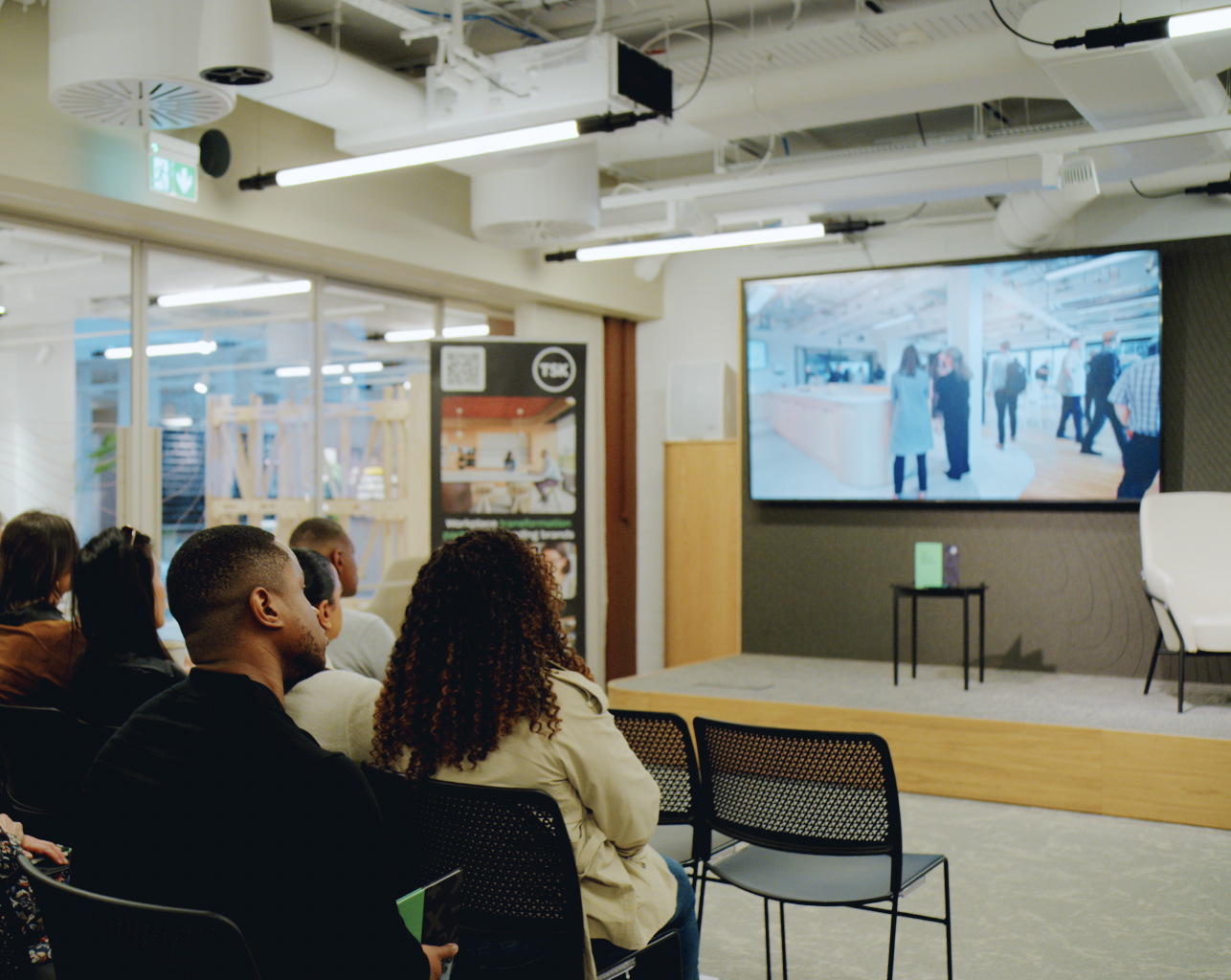
The series also grounded these themes in lived organisational experience. In Manchester, Ben Turner shared a client-side perspective on workplace transformation during a fireside chat with Hannah Cusack, reflecting on what it takes to deliver meaningful change and embed new ways of working in practice. In London, Jason Cousins added a practical occupier view on how organisations are responding in real time to changing expectations and constraints.
Taken together, the conversations pointed to a more mature view of hybrid working. The most effective workplaces are not those designed to bring people back through obligation. They are the ones shaped around a clear understanding of purpose, experience and performance. They recognise that the office has to earn its role, and that leadership teams need stronger evidence, sharper intent and better alignment between workplace strategy and business need.
This is why these discussions matter. Hybrid working has moved beyond a temporary adjustment and become a long-term leadership question. The organisations responding well are those treating workplace as a strategic asset, one that can support culture, decision-making, attraction, efficiency and long-term resilience when approached with clarity.

We’re grateful to everyone who contributed to the conversation across Manchester, London and Newcastle. What made the series valuable was not only the breadth of perspectives in the room, but a shared willingness to engage seriously with how workplace strategy now needs to evolve.
Hybrid working is no longer a question of policy alone. For leadership teams, the more pressing issue is how to create workplaces that genuinely support performance, connection and better decision-making.
That was the focus of our recent Hybrid Equation Knowledge Exchanges series, which brought together clients, market voices and workplace specialists across Manchester, London and Newcastle. While each session offered a different perspective, the central theme remained consistent. Organisations need to move beyond attendance as a measure of success and become far clearer about why people come together, what the workplace needs to enable and how those decisions are made.
This matters because the workplace is under new pressure to perform. It must work harder for the business, the people using it and the wider demands being placed on real estate, investment and sustainability. In that context, hybrid working is not simply about flexibility. It is about intent.
That theme was explored by Danielle Adler and Nicola Warburton through The Hybrid Equation, which considers how people, place, planet and process need to work together to create workplaces people actively choose to use. Their perspective challenged the idea that office use should be judged by presence alone, instead focusing on the value created when people come together with purpose.
The market perspective reinforced that shift. In Manchester, David Porter shared the agent’s view on how prolonged uncertainty has shaped occupier behaviour and increased expectations around quality, flexibility and value. In London, Tom Bolland built on that with data-led insight into market trends, highlighting growing demand for high-quality space and the rising cost of delayed decision-making in a competitive environment. In Newcastle, Greg Davison added a further perspective on how market dynamics continue to influence decisions around space and timing.
Across all three sessions, Chris Moriarty focused on employee experience and a challenge many organisations continue to face: fragmented feedback, inconsistent data and limited clarity on what people actually need from the workplace. The leadership implication is clear. Better workplace decisions require better insight, not louder assumptions.
The series also grounded these themes in lived organisational experience. In Manchester, Ben Turner shared a client-side perspective on workplace transformation during a fireside chat with Hannah Cusack, reflecting on what it takes to deliver meaningful change and embed new ways of working in practice. In London, Jason Cousins added a practical occupier view on how organisations are responding in real time to changing expectations and constraints.
Taken together, the conversations pointed to a more mature view of hybrid working. The most effective workplaces are not those designed to bring people back through obligation. They are the ones shaped around a clear understanding of purpose, experience and performance. They recognise that the office has to earn its role, and that leadership teams need stronger evidence, sharper intent and better alignment between workplace strategy and business need.
This is why these discussions matter. Hybrid working has moved beyond a temporary adjustment and become a long-term leadership question. The organisations responding well are those treating workplace as a strategic asset, one that can support culture, decision-making, attraction, efficiency and long-term resilience when approached with clarity.
We’re grateful to everyone who contributed to the conversation across Manchester, London and Newcastle. What made the series valuable was not only the breadth of perspectives in the room, but a shared willingness to engage seriously with how workplace strategy now needs to evolve.

Hybrid working is no longer a question of policy alone. For leadership teams, the more pressing issue is how to create workplaces that genuinely support performance, connection and better decision-making.
That was the focus of our recent Hybrid Equation Knowledge Exchanges series, which brought together clients, market voices and workplace specialists across Manchester, London and Newcastle. While each session offered a different perspective, the central theme remained consistent. Organisations need to move beyond attendance as a measure of success and become far clearer about why people come together, what the workplace needs to enable and how those decisions are made.
This matters because the workplace is under new pressure to perform. It must work harder for the business, the people using it and the wider demands being placed on real estate, investment and sustainability. In that context, hybrid working is not simply about flexibility. It is about intent.
That theme was explored by Danielle Adler and Nicola Warburton through The Hybrid Equation, which considers how people, place, planet and process need to work together to create workplaces people actively choose to use. Their perspective challenged the idea that office use should be judged by presence alone, instead focusing on the value created when people come together with purpose.
The market perspective reinforced that shift. In Manchester, David Porter shared the agent’s view on how prolonged uncertainty has shaped occupier behaviour and increased expectations around quality, flexibility and value. In London, Tom Bolland built on that with data-led insight into market trends, highlighting growing demand for high-quality space and the rising cost of delayed decision-making in a competitive environment. In Newcastle, Greg Davison added a further perspective on how market dynamics continue to influence decisions around space and timing.
Across all three sessions, Chris Moriarty focused on employee experience and a challenge many organisations continue to face: fragmented feedback, inconsistent data and limited clarity on what people actually need from the workplace. The leadership implication is clear. Better workplace decisions require better insight, not louder assumptions.
The series also grounded these themes in lived organisational experience. In Manchester, Ben Turner shared a client-side perspective on workplace transformation during a fireside chat with Hannah Cusack, reflecting on what it takes to deliver meaningful change and embed new ways of working in practice. In London, Jason Cousins added a practical occupier view on how organisations are responding in real time to changing expectations and constraints.
Taken together, the conversations pointed to a more mature view of hybrid working. The most effective workplaces are not those designed to bring people back through obligation. They are the ones shaped around a clear understanding of purpose, experience and performance. They recognise that the office has to earn its role, and that leadership teams need stronger evidence, sharper intent and better alignment between workplace strategy and business need.
This is why these discussions matter. Hybrid working has moved beyond a temporary adjustment and become a long-term leadership question. The organisations responding well are those treating workplace as a strategic asset, one that can support culture, decision-making, attraction, efficiency and long-term resilience when approached with clarity.
We’re grateful to everyone who contributed to the conversation across Manchester, London and Newcastle. What made the series valuable was not only the breadth of perspectives in the room, but a shared willingness to engage seriously with how workplace strategy now needs to evolve.