


Download for free now
Thank you! Your submission has been received!
Oops! Something went wrong while submitting the form.


One of the main drivers was to encourage people back into the office after COVID. The old setup wasn’t working – it had too many desks, not enough meeting rooms, and very little social space. IDHL were bringing eight agencies together under one roof, and the different teams worked in different ways. Acoustics were a huge priority to enable people to collaborate and socialise without disturbing those who need focus. We had to create a space that could support everyone's needs.
It was about giving employees flexibility to choose how they work best. And, of course, we had to consider how the workplace would support neurodiversity. This meant prioritising comfort, considering things like brightness levels, and making sure there were spaces for different work styles.
The new office supports various activities – there is a mixture of meeting rooms for focused discussions, quiet zones for deep work, phone booths for private conversations, and plenty of social areas. We introduced hot-desking, but there are also designated spaces for those who prefer consistency.
After working remotely during the pandemic, employees had grown used to home comforts. So, we moved away from the typical formal office environment and designed a space that feels warm and inviting. Comfortable sofas, a fireplace, and lounge-style seating offer the staff a relaxed, familiar atmosphere. And, of course, the coffee machine has become a focal point.
IDHL’s workplace isn’t just for employees – it’s also a place to host clients and visitors. So, it was important for the office to feel intuitive and easy to navigate. Instead of a traditional reception, we designed an informal landing space that immediately feels open and welcoming. It’s a big office, which can feel daunting, so we introduced smaller areas for meetings and collaboration. You can’t see all the staff at any one point in this building.
Wayfinding was key, too. Moving into a new office can be disorienting, so there’s a clear journey through the space – showing people where to grab a coffee, where to hang their coats, and where to find the right type of meeting space. We put together a user guide, which helps people understand the new space and how everything works. It’s important to remember that, yes, we’re changing an office, but it’s also a huge change to how people operate in the space. The guide helps people make that transition.

We designed a large social hub with a central island, which doubles as a town hall space for company-wide meetings. The area can easily adapt to events such as presentations, get-togethers, and even pizza nights.
The amphitheatre-style seating is a real highlight. Traditionally, big meetings happen in conference rooms, where everyone sits at the same level. But for here, we chose a tiered seating space, where people naturally gravitate for team gatherings. Employees prefer meeting here than in traditional boardrooms!

The podcast room was a particularly interesting challenge. IDHL knew they wanted one but weren’t sure how exactly it needed to function. Was it for filmed recordings? Audio podcasts?
We designed it to be multi-functional – it doubles up as a lounge and a podcast room. It’s comfortable enough for casual conversations but professional enough for high-quality recordings. And because it’s such a great space, employees now use it as a quiet retreat as well. That’s the beauty of flexible design – it can adapt to people’s needs over time.
Instead of just splashing their logo everywhere, we chose subtle, meaningful touches. We used their signature colours in a way that felt modern and understated and focused on developing a visual and sensory experience that was unmistakably “IDHL”.
We wanted their visitors and clients to get a real feel for IDHL’s energy. So, we changed the way they brought clients into the space. Previously, visitors were taken straight to a meeting room. Now, they’re brought into this buzzing landing space, where they get a great view of the rest of the office and immediately see the teams in action. It’s a small shift, but it makes a huge difference in reinforcing who IDHL is as a company.
.jpg)
There’s a lot to be proud of, but one of the biggest things is that once we completed this project in Leeds, IDHL wanted to recreate the experience in Manchester. This reinforces that we made the right decisions. There’s been an uptake of people going into Leeds and Manchester, and it’s great to hear IDHL are continuing to listen to their staff and finding out what’s working for them.
By making the office somewhere people actually want to be, you naturally encourage more engagement, collaboration and energy. In fact, employees from Harrogate started commuting to the Leeds office because they preferred the space. Because of this, IDHL actually decided to close their Harrogate office. That speaks volumes!
Want to know more about IDHL’s transformation project in Leeds? Read the full case study here.
One of the main drivers was to encourage people back into the office after COVID. The old setup wasn’t working – it had too many desks, not enough meeting rooms, and very little social space. IDHL were bringing eight agencies together under one roof, and the different teams worked in different ways. Acoustics were a huge priority to enable people to collaborate and socialise without disturbing those who need focus. We had to create a space that could support everyone's needs.
It was about giving employees flexibility to choose how they work best. And, of course, we had to consider how the workplace would support neurodiversity. This meant prioritising comfort, considering things like brightness levels, and making sure there were spaces for different work styles.
The new office supports various activities – there is a mixture of meeting rooms for focused discussions, quiet zones for deep work, phone booths for private conversations, and plenty of social areas. We introduced hot-desking, but there are also designated spaces for those who prefer consistency.
After working remotely during the pandemic, employees had grown used to home comforts. So, we moved away from the typical formal office environment and designed a space that feels warm and inviting. Comfortable sofas, a fireplace, and lounge-style seating offer the staff a relaxed, familiar atmosphere. And, of course, the coffee machine has become a focal point.
IDHL’s workplace isn’t just for employees – it’s also a place to host clients and visitors. So, it was important for the office to feel intuitive and easy to navigate. Instead of a traditional reception, we designed an informal landing space that immediately feels open and welcoming. It’s a big office, which can feel daunting, so we introduced smaller areas for meetings and collaboration. You can’t see all the staff at any one point in this building.
Wayfinding was key, too. Moving into a new office can be disorienting, so there’s a clear journey through the space – showing people where to grab a coffee, where to hang their coats, and where to find the right type of meeting space. We put together a user guide, which helps people understand the new space and how everything works. It’s important to remember that, yes, we’re changing an office, but it’s also a huge change to how people operate in the space. The guide helps people make that transition.
We designed a large social hub with a central island, which doubles as a town hall space for company-wide meetings. The area can easily adapt to events such as presentations, get-togethers, and even pizza nights.
The amphitheatre-style seating is a real highlight. Traditionally, big meetings happen in conference rooms, where everyone sits at the same level. But for here, we chose a tiered seating space, where people naturally gravitate for team gatherings. Employees prefer meeting here than in traditional boardrooms!
The podcast room was a particularly interesting challenge. IDHL knew they wanted one but weren’t sure how exactly it needed to function. Was it for filmed recordings? Audio podcasts?
We designed it to be multi-functional – it doubles up as a lounge and a podcast room. It’s comfortable enough for casual conversations but professional enough for high-quality recordings. And because it’s such a great space, employees now use it as a quiet retreat as well. That’s the beauty of flexible design – it can adapt to people’s needs over time.
Instead of just splashing their logo everywhere, we chose subtle, meaningful touches. We used their signature colours in a way that felt modern and understated and focused on developing a visual and sensory experience that was unmistakably “IDHL”.
We wanted their visitors and clients to get a real feel for IDHL’s energy. So, we changed the way they brought clients into the space. Previously, visitors were taken straight to a meeting room. Now, they’re brought into this buzzing landing space, where they get a great view of the rest of the office and immediately see the teams in action. It’s a small shift, but it makes a huge difference in reinforcing who IDHL is as a company.
There’s a lot to be proud of, but one of the biggest things is that once we completed this project in Leeds, IDHL wanted to recreate the experience in Manchester. This reinforces that we made the right decisions. There’s been an uptake of people going into Leeds and Manchester, and it’s great to hear IDHL are continuing to listen to their staff and finding out what’s working for them.
By making the office somewhere people actually want to be, you naturally encourage more engagement, collaboration and energy. In fact, employees from Harrogate started commuting to the Leeds office because they preferred the space. Because of this, IDHL actually decided to close their Harrogate office. That speaks volumes!
Want to know more about IDHL’s transformation project in Leeds? Read the full case study here.
One of the main drivers was to encourage people back into the office after COVID. The old setup wasn’t working – it had too many desks, not enough meeting rooms, and very little social space. IDHL were bringing eight agencies together under one roof, and the different teams worked in different ways. Acoustics were a huge priority to enable people to collaborate and socialise without disturbing those who need focus. We had to create a space that could support everyone's needs.
It was about giving employees flexibility to choose how they work best. And, of course, we had to consider how the workplace would support neurodiversity. This meant prioritising comfort, considering things like brightness levels, and making sure there were spaces for different work styles.
The new office supports various activities – there is a mixture of meeting rooms for focused discussions, quiet zones for deep work, phone booths for private conversations, and plenty of social areas. We introduced hot-desking, but there are also designated spaces for those who prefer consistency.
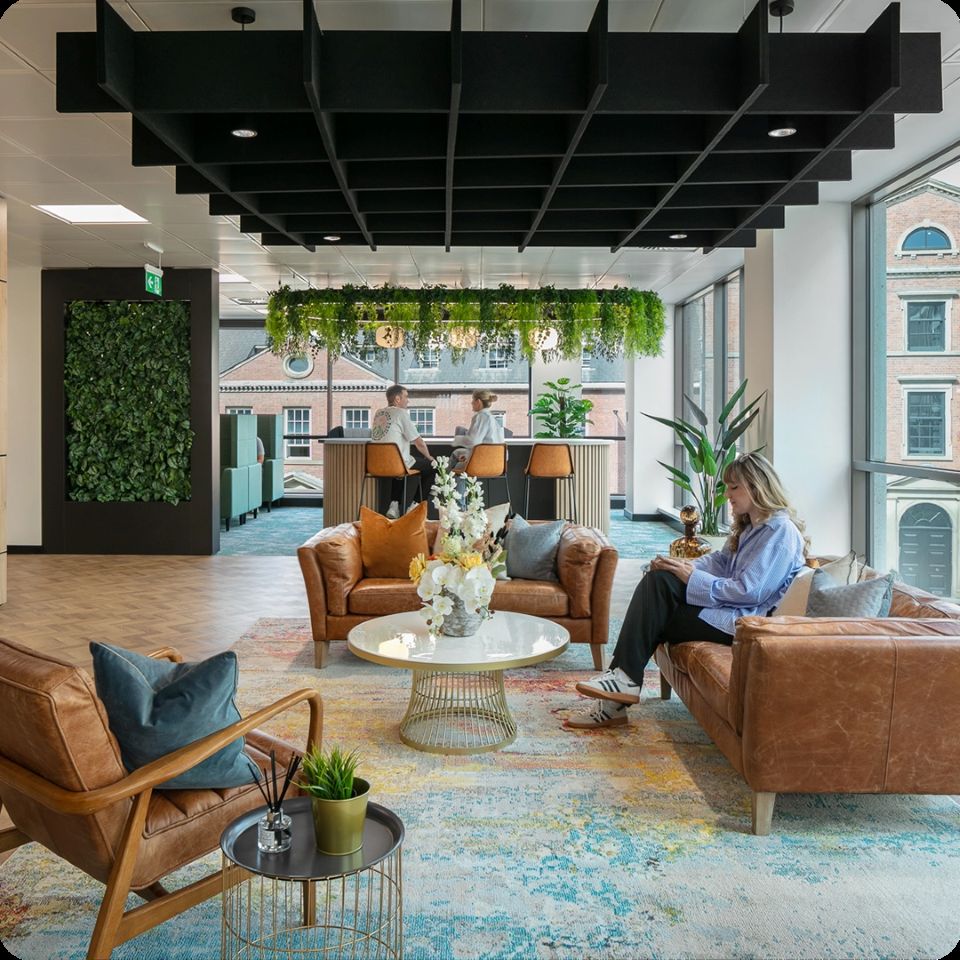
After working remotely during the pandemic, employees had grown used to home comforts. So, we moved away from the typical formal office environment and designed a space that feels warm and inviting. Comfortable sofas, a fireplace, and lounge-style seating offer the staff a relaxed, familiar atmosphere. And, of course, the coffee machine has become a focal point.
IDHL’s workplace isn’t just for employees – it’s also a place to host clients and visitors. So, it was important for the office to feel intuitive and easy to navigate. Instead of a traditional reception, we designed an informal landing space that immediately feels open and welcoming. It’s a big office, which can feel daunting, so we introduced smaller areas for meetings and collaboration. You can’t see all the staff at any one point in this building.
Wayfinding was key, too. Moving into a new office can be disorienting, so there’s a clear journey through the space – showing people where to grab a coffee, where to hang their coats, and where to find the right type of meeting space. We put together a user guide, which helps people understand the new space and how everything works. It’s important to remember that, yes, we’re changing an office, but it’s also a huge change to how people operate in the space. The guide helps people make that transition.
We designed a large social hub with a central island, which doubles as a town hall space for company-wide meetings. The area can easily adapt to events such as presentations, get-togethers, and even pizza nights.
The amphitheatre-style seating is a real highlight. Traditionally, big meetings happen in conference rooms, where everyone sits at the same level. But for here, we chose a tiered seating space, where people naturally gravitate for team gatherings. Employees prefer meeting here than in traditional boardrooms!
The podcast room was a particularly interesting challenge. IDHL knew they wanted one but weren’t sure how exactly it needed to function. Was it for filmed recordings? Audio podcasts?
We designed it to be multi-functional – it doubles up as a lounge and a podcast room. It’s comfortable enough for casual conversations but professional enough for high-quality recordings. And because it’s such a great space, employees now use it as a quiet retreat as well. That’s the beauty of flexible design – it can adapt to people’s needs over time.
Instead of just splashing their logo everywhere, we chose subtle, meaningful touches. We used their signature colours in a way that felt modern and understated and focused on developing a visual and sensory experience that was unmistakably “IDHL”.
We wanted their visitors and clients to get a real feel for IDHL’s energy. So, we changed the way they brought clients into the space. Previously, visitors were taken straight to a meeting room. Now, they’re brought into this buzzing landing space, where they get a great view of the rest of the office and immediately see the teams in action. It’s a small shift, but it makes a huge difference in reinforcing who IDHL is as a company.
There’s a lot to be proud of, but one of the biggest things is that once we completed this project in Leeds, IDHL wanted to recreate the experience in Manchester. This reinforces that we made the right decisions. There’s been an uptake of people going into Leeds and Manchester, and it’s great to hear IDHL are continuing to listen to their staff and finding out what’s working for them.
By making the office somewhere people actually want to be, you naturally encourage more engagement, collaboration and energy. In fact, employees from Harrogate started commuting to the Leeds office because they preferred the space. Because of this, IDHL actually decided to close their Harrogate office. That speaks volumes!
Want to know more about IDHL’s transformation project in Leeds? Read the full case study here.